
Better Practice Social Licence Guideline + Review
An evolving and independently reviewed improvement pathway for transmission companies in the energy transition.
Why this matters
The #BetterTogether Better Practice Social Licence Guideline exists for one reason: to lift trust through transparent commitments and independent scrutiny. Working with the Ag Energy Taskforce, it sets clear co-designed expectations for how transmission and renewable businesses minimise impacts, improve co-existence with agriculture and deliver shared value, then prove progress publicly through a structured accountability cycle.
Impact
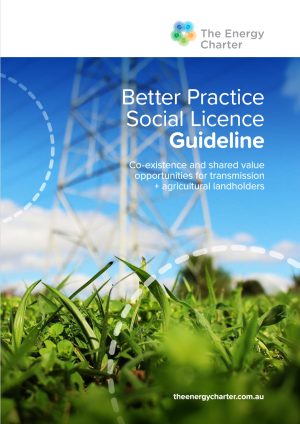
Better Practice Social Licence Guideline
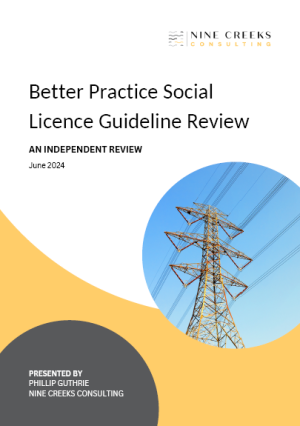
Independent Review 2024
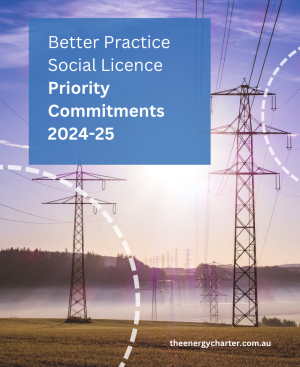
Priority Commitments 2025
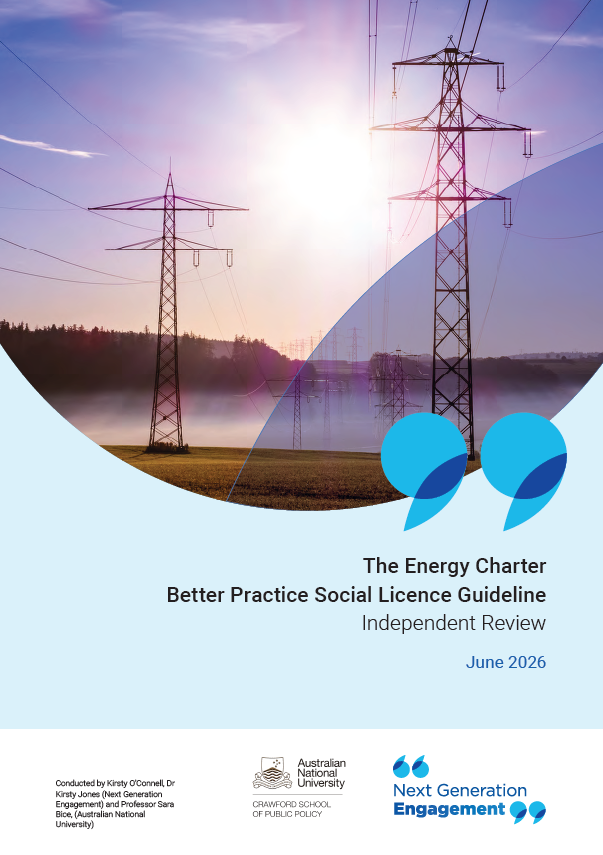
Independent Review 2026
We don’t mark our own homework. The Better Practice Guideline is backed by a rolling independent accountability program designed to drive continuous improvement, grounded in evidence and co-design with the people most affected.
- Independent research (2022) - The Guideline was informed by independent lived experience research into landholder and agricultural stakeholder experiences, risks and priorities. This evidence base ensured the work was grounded in real-world impacts, not theory.
- Co-design of the Guideline (2023) - The Guideline itself was co-designed with agriculture, community and industry voices ensuring it reflects practical on-the-ground realities and shared expectations for better practice. This collaborative design phase established the initial actions and focus areas for improving social licence with agricultural communities.
- 1st Independent Review (2024) - In June 2024, Nine Creeks Consulting completed the first Independent Review, informed by community and participating transmission business' input, with practical recommendations for improvement. This review tested whether implementation was delivering meaningful change.
- Co-designed 20 Priority Commitments (late 2024) - Following the review, our Community Outcomes Group and Industry Collaborators jointly distilled the learning into 20 Priority Commitments to focus effort where it matters most. These commitments sharpen accountability and make progress measurable.
- Quarterly reporting to the Ag Energy Taskforce (2023-2025) - Collaborators provide quarterly updates through the Ag Energy Taskforce to keep momentum and accountability live. This creates regular visibility of progress, barriers and emerging risks. Read the transmission business' 2025 Accountability Progress Reviews here to Ag Energy Taskforce.
- 2nd Independent Review (2026) - A second Independent Review was completed by Next Generation Engagement + The Australian National University in 2026 to assess progress against the 20 Priority Commitments with Ag Energy Taskforce engagement. A public launch was hosted by Joy Thomas, Independent Chair of the Ag Energy Taskforce in late June.
„
Accountability is key to building trust. The quarterly updates under the Better Practice Social Licence Guideline show a real commitment from transmission businesses to not just say the right things – but to do better and be able to actively demonstrate that they are doing better – for landholders and regional communities.
Joy Thomas, Independent Chair, Ag Energy Infrastructure Taskforce
Collaborators
Community Outcomes Group
- National Farmers’ Federation
- AgForce Queensland
- Australian Dairy Farmers
- Australian Dairy Products Federation
- Australian Grape and Wine
- Canegrowers
- Central Irrigation Trust (Barmera, SA)
- Cotton Australia
- Dairy Australia (VIC)
- Farmers for Climate Action
- Grain Industry Association of WA
- NSW Farmers Association
- Pioneer Valley Water (Mackay, QLD)
- Primary Producers South Australia
- Queensland Farmers’ Federation
- Renewables in Agriculture Conference Founder (Karin Stark)
- Tasmanian Farmers and Graziers Association
- Victorian Farmers’ Federation
- Wimmera Southern Mallee Development.
Industry Collaborators
The Energy Charter Signatories:
- AusNet Services
- Marinus Link
- Powerlink Queensland
- TasNetworks
- Transgrid.
Resources + additional information
Download the Second Independent Review of the Better Practice Social Licence Guideline
The second Independent Review by Next Generation Engagement and Australian National University has been completed to assess participating transmission business’ progress towards implementing the 20 Priority Actions contained in the Social Licence Guideline and provide constructive feedback to support continuous improvement.
Launch event of Second Independent Review
A massive thank you to our guest speakers at the launch of the 2nd Independent Review on Monday, 29 June 2026:
- Hosted by Joy Thomas, Independent Chair, Ag Energy Taskforce
- Kirsty O’Connell, Co-Founder and Director, Next Generation Engagement
- Professor Sara Bice, Co-Founder and Director, I2S (Institute for Infrastructure in Society) at the Crawford School of Public Policy, The Australian National University
- Sabiene Heindl, CEO, The Energy Charter
Better Practice Social Licence Priority Commitments 2024-25
Five Energy Charter Signatories: AusNet Services, Marinus Link, Powerlink Qld, TasNetworks and Transgrid have re-committed to a further 18-month period (July 2024 – December 2025) of implementing better practices followed by a second Independent Review. In consultation with our Community Outcomes Group, 20 priority actions have been agreed to be of focus in this second phase.
Better Practice Social Licence Guideline Independent Review 2024
The 12-month Independent Review provides an important opportunity to review and reflect on the implementation of the Better Practice Social Licence Guideline by participating transmission businesses.
The purpose of this first Independent Review was to assess progress towards implementing the Priority Actions and Better Practice Opportunities contained in the Better Practice Social Licence Guideline and provide constructive feedback to support continuous improvement efforts.
The Independent Review used a mixed-method approach, including 12 semi-structured interviews with Community Outcome Group members and transmission businesses, and a review of the 6 and 12-Month Progress Reports provided by each business.
This Independent Review was produced by Phillip Guthrie, Partner at Nine Creeks Consulting who has an extensive consulting background, and he has undertaken work in regional development and agricultural extension, with a focus on agriculture technology.
Better Practice Social Licence Guideline
This Better Practice Guideline is the result of an Energy Charter #BetterTogether collaboration. It was co-developed by landholder and community representatives and a group of electricity transmission businesses to:
- Build a shared understanding of the impacts and potential benefits associated with hosting energy transmission infrastructure for agricultural landholders
- Provide practical social licence to operate (‘social licence’) guidance to mitigate negative impacts and prioritise shared value through the energy transition.
This #BetterTogether initiative aligns with:

Principle 3: We will provide energy safely, sustainably and reliably.

Learn more
Speak to Roger Marshall, Director, Energy Transition, to learn more about the #BetterTogether Better Practice Social Licence Guideline + Review.