/* Style Definitions */
table.MsoNormalTable
{mso-style-name:"Table Normal";
mso-tstyle-rowband-size:0;
mso-tstyle-colband-size:0;
mso-style-noshow:yes;
mso-style-priority:99;
mso-style-parent:"";
mso-padding-alt:0in 5.4pt 0in 5.4pt;
mso-para-margin-top:0in;
mso-para-margin-right:0in;
mso-para-margin-bottom:8.0pt;
mso-para-margin-left:0in;
line-height:107%;
mso-pagination:widow-orphan;
font-size:11.0pt;
font-family:"Calibri",sans-serif;
mso-ascii-font-family:Calibri;
mso-ascii-theme-font:minor-latin;
mso-hansi-font-family:Calibri;
mso-hansi-theme-font:minor-latin;
mso-bidi-font-family:"Times New Roman";
mso-bidi-theme-font:minor-bidi;
mso-font-kerning:1.0pt;
mso-ligatures:standardcontextual;
mso-ansi-language:EN-AU;}
An essential connection to services and assistance
The Energy Charter’s Disaster Response Playbook recognises that following a disaster event, utility service providers are often a first point of contact for people as they provide an essential service for recovery.
They are an important part of the disaster response and recovery ecosystem as a ‘connector’ to other services and assistance. However, sometimes staff:
- Lack the training and feel unprepared to support customers and peers who have experienced trauma, which can have negative impacts for mental health and wellbeing of both parties.
- Are unclear on what the scope of their role is when responding to a disaster (i.e., when to refer to another service) which leaves them trying to ‘do it all’.
- Experience personal trauma as a result the disaster, while also playing professional role in disaster response and recovery activities.
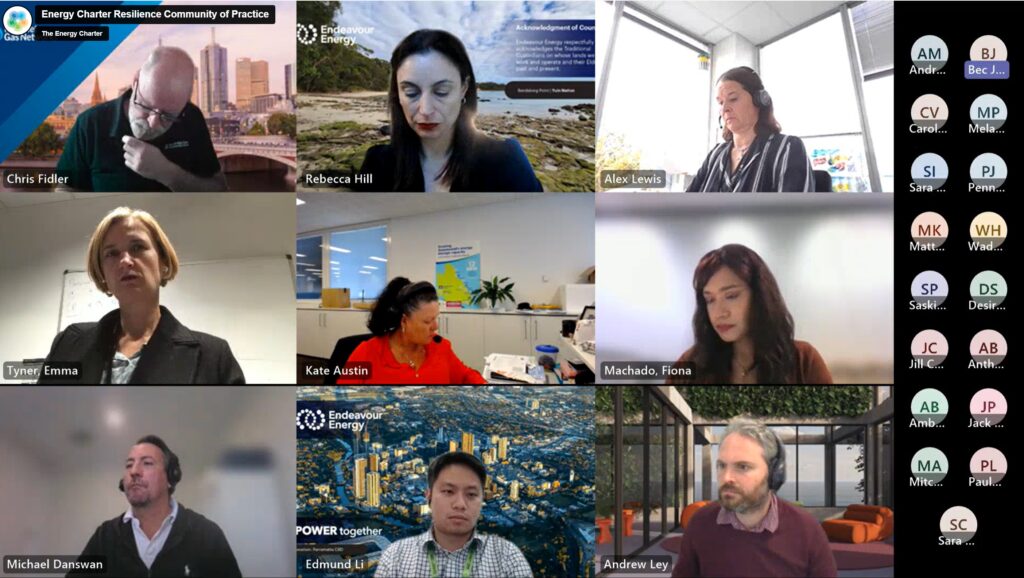
In our July Resilience Community of Practice, Alexandra Howard, Director, Disasters and Public Health Emergencies at Phoenix Australia offered strategies to help staff better recognise and respond to trauma in disaster impacted communities.
/* Style Definitions */
table.MsoNormalTable
{mso-style-name:"Table Normal";
mso-tstyle-rowband-size:0;
mso-tstyle-colband-size:0;
mso-style-noshow:yes;
mso-style-priority:99;
mso-style-parent:"";
mso-padding-alt:0in 5.4pt 0in 5.4pt;
mso-para-margin-top:0in;
mso-para-margin-right:0in;
mso-para-margin-bottom:8.0pt;
mso-para-margin-left:0in;
line-height:107%;
mso-pagination:widow-orphan;
font-size:11.0pt;
font-family:"Calibri",sans-serif;
mso-ascii-font-family:Calibri;
mso-ascii-theme-font:minor-latin;
mso-hansi-font-family:Calibri;
mso-hansi-theme-font:minor-latin;
mso-bidi-font-family:"Times New Roman";
mso-bidi-theme-font:minor-bidi;
mso-font-kerning:1.0pt;
mso-ligatures:standardcontextual;
mso-ansi-language:EN-AU;}
Here’s our key takeaways from Alex’s session
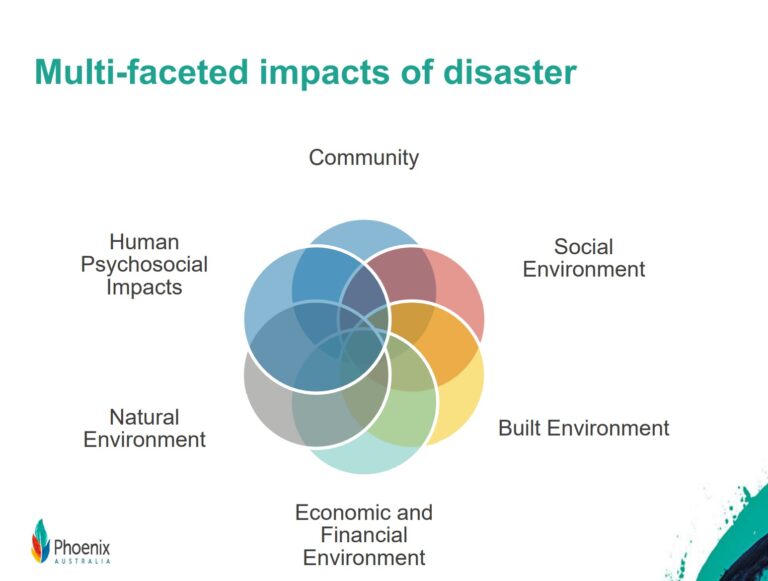
Disaster impacts are multi-faceted with impacts across multiple areas.
Within the essential services sector, we can often be focused on responding to build environment and economic/financial impacts. However, whether we know it or not, most of us in the disaster eco-system, also have a role in human phyco-social impacts